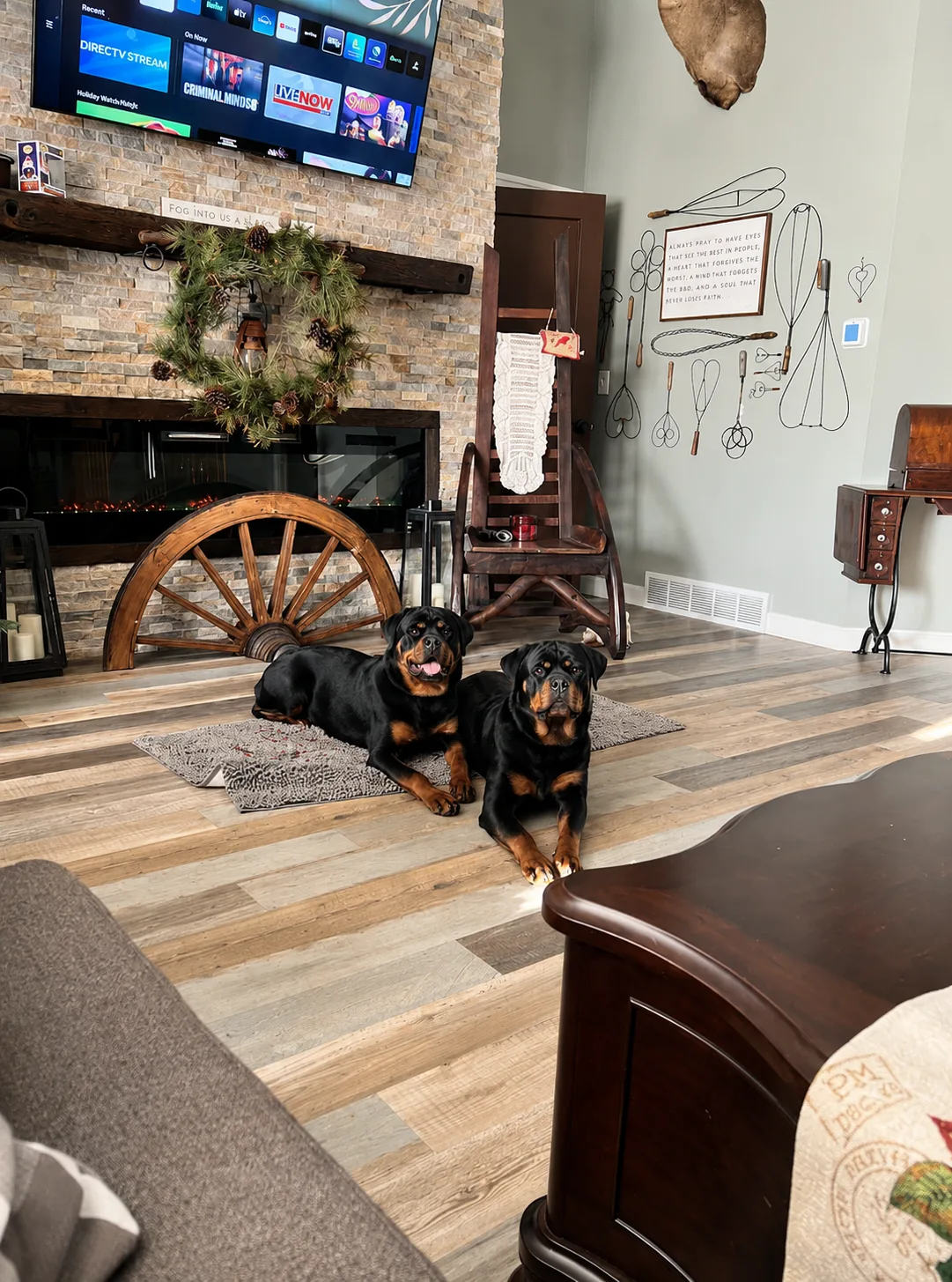
Ask ten strangers what a Rottweiler is like and most will answer before they have ever met one. The reputation arrives first. This is Part II of our breed series: what a correct Rottweiler temperament actually is, where the myth of the “aggressive Rottweiler” came from, and how breeding and raising decide which dog your puppy grows into.
What the standard actually asks for
The breed standard is unambiguous. It calls for a dog that is calm, confident, and courageous, with a self-assured aloofness that does not lend itself to immediate and indiscriminate friendships, and a wait-and-see attitude toward new people and situations. Read that carefully. Not suspicious. Not hostile. Discerning. A correct Rottweiler notices a stranger, forms an opinion, and then decides. That is a thinking dog — and it is the opposite of a reactive one.
The same standard asks for a dog that is placid, good-natured, and devoted at home. Both halves describe the same animal. The Rottweiler was built to be completely trustworthy with the people it lives with and level-headed with everyone else.
Where the myth came from
The Rottweiler did not change. The people breeding and buying it did. When the breed surged in popularity through the 1980s and 1990s, becoming one of the most registered breeds in America, demand outran responsibility. Dogs were bred for size, for looks, or simply because two happened to be available — with no thought given to nerve strength or health. Some were sought out precisely for intimidation and raised to deliver it. The result was predictable: unstable dogs in the wrong hands, headlines, and breed bans.
None of that is the breed. It is what happens to any powerful breed the moment breeding stops being selective. The fix was never a different dog. It was a better breeder and a better owner.
Stable versus sharp: learning the difference
Breeders use two words that matter more than any other. A stable dog is neutral toward strangers, curious rather than alarmed by new things, startles and then recovers quickly, and thinks before it acts. A sharp or nervous dog reacts first, treats the unfamiliar as a threat, and cannot settle.
Here is the part that surprises people: the fearful dog is the dangerous one. Aggression in Rottweilers is overwhelmingly fear-based. Confidence is the safety feature. A truly confident Rottweiler has nothing to prove, and so it proves nothing — it simply watches, and waits.
You can see this for yourself. Meet the parents. Watch how the dam greets you — she should be composed, perhaps reserved, never frantic and never cowering. Drop something. Make a new noise. A dog that startles and shakes it off is showing you strong nerves. One that stays on edge is not.
Temperament is inherited first
Nerve strength — the ability to stay clear-headed under pressure — is heritable. Generations of breeding for stable minds produce puppies born with a wider margin of composure. Generations of ignoring it produce the opposite. Training can manage weak nerves; it cannot replace them.
This is why the living parents tell you more than the pedigree ever will. Health clearances speak to hips and eyes. Only the dogs themselves speak to temperament. A breeder who selects for it will be glad to show you — and a breeder who cannot show you should give you pause.
Then it is shaped: the window that closes
Genetics set the range. Raising decides where in that range the dog lands. The most important period of a Rottweiler's life is roughly three to fourteen weeks of age — the socialization window — when the puppy's brain is deciding what counts as normal. What it meets calmly during that time, it accepts for life. What it never meets, it may fear.
A large share of that window passes before the puppy ever goes home. That is why the breeder's protocol matters so much: early neurological stimulation in the first two weeks, daily handling, different surfaces and sounds, different people, gentle novelty every day. A puppy started this way arrives with a foundation already poured.
Then it passes to you. The weeks after homecoming are the second half of the same window. Calm exposure to people, places, vehicles, other dogs, children — not flooding, not isolation, but steady, positive introduction. A puppy that has been well started and then shown the world becomes the dog the standard describes.
Guardian, not guard dog
People often ask whether a Rottweiler needs protection training. A correct one does not. The protective instinct is discernment — the dog reads the situation and its people, and responds in proportion. It is not something you install. It is something you trust.
A Rottweiler that has to be taught to be suspicious is missing something the breed should carry. A Rottweiler that cannot learn to relax is missing something too. The dog you want is the one that lies at your feet all evening, and rises without hesitation the one time it truly matters.
What this means for you
Choose the breeder before you choose the puppy. Temperament and health together, not one or the other. Meet the parents, and watch them more than you listen. Ask what happens before eight weeks — a serious program can describe its early-development protocol in detail. Keep going once the puppy is home: socialization does not finish at pickup. And lead with calm consistency. A Rottweiler with a steady leader and a purpose is one of the most reliable dogs alive.
This article is general breed education. Every dog is an individual — your breeder and your veterinarian are your best resources for guidance specific to your dog.
At Crosspoint, temperament is not an afterthought to structure. It is evaluated in both dogs before a pairing is planned, and every puppy is raised under a structured early-development protocol from the first days of life. The confident, devoted Rottweiler is not a myth. It is the breed, bred correctly.
Next in the series — Part III: Structure — Why a Working Build Still Matters. Bone, angulation, movement, and type: what correct build looks like, and why it is far more than looks.