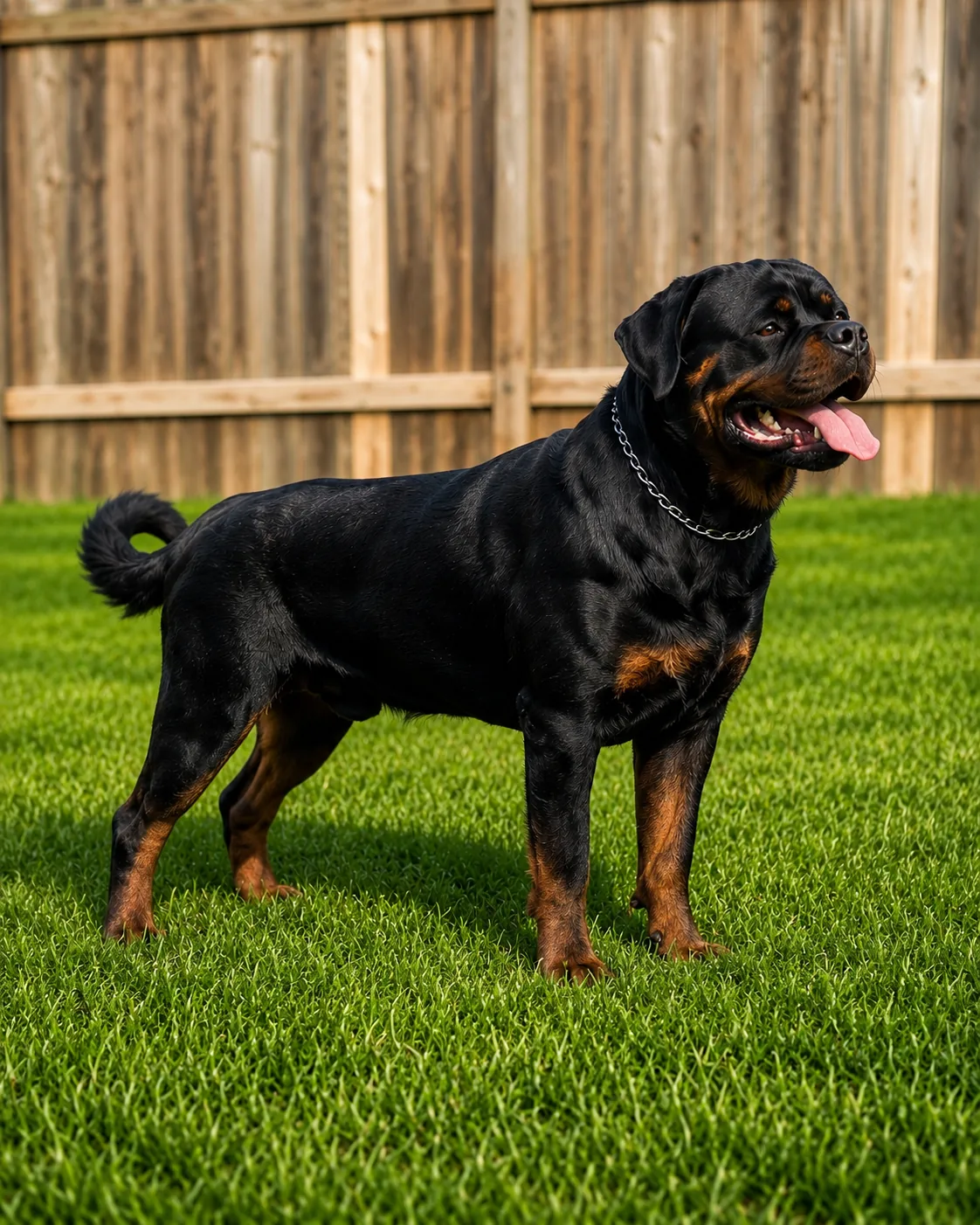
Every line of the Rottweiler standard traces back to a job: droving cattle across open country and pulling loaded carts through the streets of Rottweil. Structure is the physical machinery that made that work possible — and it is what keeps a dog sound for a lifetime. This is Part III of our breed series: what correct build looks like, why it is far more than appearance, and what to look for in the parents of your puppy.
Form follows function
The standard describes a medium-large, robust, and powerful dog — “neither heavy nor light, neither leggy nor weedy.” Compact and substantial, built to move all day and still have strength in reserve. Every trait below earned its place because it served the work. Structure is not decoration. It is the reason the dog can do what it was made to do, and keep doing it at ten years old.
The head carries the breed
Broad between the ears, with a moderately arched forehead and a well-defined stop. A muzzle that is broad at the base and strong, never snipey. Dark, almond-shaped eyes; medium triangular ears set high and lying close to the head. The rust markings are exact — over each eye, on the cheeks, the muzzle, the chest, the legs, and beneath the tail. The expression should read as noble, alert, and self-assured.
The head carries the breed's character. A correct head is instantly recognizable as a Rottweiler and nothing else. Males should be unmistakably masculine; females feminine without any loss of substance.
Bone and substance
Heavy bone. A deep chest, broad forechest, and well-sprung ribs. Substance is the breed — but substance is not bulk, and the standard specifically warns against coarseness and overweight. Males typically stand 24 to 27 inches at the shoulder and females 22 to 25, with weight in proportion. A bigger dog is not a better dog if the size costs it movement or soundness. The right Rottweiler is powerful and athletic in the same body.
Angulation and balance
Angulation is simply the angle of the joints — shoulder and upper arm in front, stifle and hock behind. Correct angulation lets the legs reach and drive efficiently instead of fighting the ground. Balance means the front and rear match. A rear angled far more than the front produces a dog that overreaches and lacks stability; a straight front produces a short, pounding stride that jars the joints with every step. Moderate, matched angulation is what the standard asks for, and it is what lasts.
Topline, and the honest test of movement
The back should be straight, strong, and level from withers to croup — a topline that holds firm in motion, neither rolling nor arching. The Rottweiler's working gait is the trot: balanced, harmonious, ground-covering, with reach in front and drive behind, the feet converging toward a center line as speed increases.
Movement is where structure becomes visible. A dog can be posed to hide a fault. It cannot move to hide one. When you evaluate a Rottweiler, watch it go. That is the truth about how it is built.
Structure and health are the same conversation
Correct structure and health testing work together, and neither replaces the other. Hip and elbow dysplasia are the breed's best-known orthopedic concerns, and a reputable breeder screens for them through OFA or PennHIP and breeds only from dogs that pass. But a dog with good hips and poor angulation still sends abnormal stress through those joints, year after year. Sound structure reduces wear. Screened joints reduce inherited risk. A breeder who does both is protecting the next twelve years of your dog's life.
Type: looking like a Rottweiler
Type is the sum of all of it — the silhouette, the head, the coat, the presence. Structure is the skeleton; type is the breed standing in front of you. A dog can be structurally sound and still lack type, or be full of type and unsound underneath. The goal is both, and it is rarer than it should be.
What to look for as a buyer
Look at the parents standing and moving — in person if you can, on video if you cannot, and not only in posed photographs. Ask to see hip and elbow clearances, and cardiac and eye results where available. Be wary of extremes: oversized heads, excessive bone, exaggerated angulation. They trade soundness for impression. At eight weeks a puppy is a preview; the parents are the truth. And ask the breeder to walk you through the dog's structure. A serious breeder can, and will be glad to.
This article is general breed education. Every dog is an individual — your breeder and your veterinarian are your best resources for guidance specific to your dog.
At Crosspoint, structure is the first question in every pairing — bone, balance, topline, and movement evaluated in both dogs before a breeding is planned. It is what we mean when we say purpose-bred: a dog built to work, and to stay sound for the life it lives beside you.
This completes The Rottweiler, Understood. Start again at Part I: Origins, Purpose & True Character, revisit Part II: Temperament, or return to the Chronicles.